Showing posts with label McKinsey. Show all posts

Tuesday, February 13, 2018

Link to Great Strategy Article

Strategy to beat the odds

One of the best strategy articles I have seen in a long time just came out from McKinsey. The summary of the article is this.

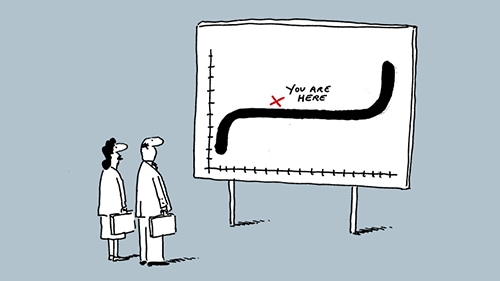
  1. Most companies are in the middle of the pack.
  2. Nearly all the profit is made by the top quintile.
  3. To get from the middle to the top, you need to make a combination of bold moves (much more dynamic than your peers) in the following areas:
      • Programmatic M&A. You need a steady stream of deals every year, each amounting to no more than 30 percent of your market cap but adding over ten years to at least 30 percent of your market cap. 
      • Dynamic reallocation of resources. Winning companies reallocate capital expenditures at a healthy clip, feeding the units that could produce a major move up the power curve while starving those unlikely to surge. 
      • Strong capital expenditure. You meet the bar on this lever if you are among the top 20 percent in your industry in your ratio of capital spending to sales. That typically means spending 1.7 times the industry median. 
      • Strength of productivity program. This means improving productivity at a rate sufficient to put you at least in the top 30 percent of your industry. 
      • Improvements in differentiation. You need business-model innovation and pricing advantages that result in raising your gross margin to the top 30 percent in your industry. 
It sounds pretty basic, but that's what makes it so powerful. Abandon the status quo, make bold moves in five areas, and the odds of improved outcome go up dramatically.

You can find a copy of the article here.

Thursday, August 25, 2016

Strategic Planning Analogy #567: Water Between the Marbles


THE STORY
When I was in Junior High School, we did an interesting science experiment. The teacher took a beaker and filled it full of marbles. He asked the class if we thought the beaker was full. We all said "Yes."

Then the teacher poured water into the beaker over top the marbles. He poured quite a bit of water into the beaker before the water reached the top. Then he poured the water surrounding the marbles out into another beaker. The second beaker was about half full of water.

So the teacher then pointed to that original beaker with marbles up to the top and re-asked his first question: “Is this beaker full?”

This time we answered “No.”


THE ANALOGY
Things can appear full even when they are not. It doesn’t matter what the container is or what you put into it. You can fill the container to the top and it still will not be full.

The problem is that little spaces form between the objects you put in the container. Each individual space may appear tiny, but when you add them up, all those spaces take up a lot of room. That’s why so much water could be put into a beaker that was supposedly “full” of marbles.

The same is true in business. A market may appear to be full, with large competitors appearing to take up all the available space. It looks like there is no room for anyone else.

However, if you stop looking at all the marbles (the big competitors) and start looking at the spaces, you will see that there is still a lot of room in that market. If you think strategically, you may still find a successful way to fill those open spaces.

  
THE PRINCIPLE
The principle here is that even in highly mature markets there always seems to be room for niche products or niche companies. The reason is because large companies tend to be best at doing the large things (serving large customer segments, large product runs, large marketing programs, etc.). They are not well designed to go after those small spaces.

These large, mass companies are like those marbles. They take up all the space that marbles are capable of taking, but they leave gaps they cannot fill.

Because water can go into smaller spaces, they can fill in the places the marbles cannot get to. Smaller niche markets and niche companies are like that water, able to penetrate spaces difficult for the large companies to effectively reach.

McKinsey Article
I saw an example of this principle in an article put out this month by McKinsey and Co. The article was looking at the consumer packaged goods (CPG) industry. This is a very mature business. Consolidation has occurred and there are only a few large companies left trying to fill the CPG space.

To get an idea of how full the CPG space is, the article states that growth for these large CPG companies over the past four years averaged only about 0.3% per year. It looks like there is no more room for these large CPG companies to stuff any more marbles into the CPG market. They’ve already tapped pretty much all they can get, right?

So does that mean every other company should walk away? Not necessarily. In the story, we saw that even when the marbles “filled” the beaker to the top, there was still room for about a half a beaker full of water in that beaker. Similarly, the McKinsey article says that even though the big CPG companies have “filled” the CPG market, about half the CPG space is filled by niches not held by the big companies.

And here’s the more exciting news. While the big companies were averaging only 0.3% growth, the article says that midsize companies were growing at 3.8% and small CPG companies were growing at an astonishing 10.2%!  So even in so-called slow growing mature markets, you can grow and prosper if you know how to get into those small spaces.

So how do you take advantage of those small spaces? Well, simply put, you have to become less like a marble and more like water. Marbles are large and rigid. Water is fluid and flexible, able to seep into small places.

There are three ways to become more like water. They are discussed below:

1) Make your Company Successful At Being Small
Large companies tend to find it hard to do small things because their very bigness tends to get in the way. They have large overhead, lots of bureaucracy, rigid rules, and an infrastructure built to exploit big opportunities.

Smaller, more nimble companies, however, are less burdened with all this rigid structure and high cost. They can be built in such a way that they can make money on small opportunities outside the reach of the big ones.

Don’t try to gain success by imitating the big guys. Gain success by structuring your business model to do things they cannot do. Stop trying to be a rigid marble. Stay fluid and flexible.

2) Target Small Opportunities
Don’t look for the big opportunities. Big opportunities attract big competitors. The big competitors will crush you there. Instead, look for the small niches which fall below the big company’s radar.

Small niches can still be pretty profitable if you know what you’re doing and are designed to optimize in a niche environment. So don’t look at where the big marbles already exist. Look at the spaces between them. Find a small space rightly sized for you, but too small for the big guys.

3) Make Big Companies Better at Doing Small Things
If you are already a big company, the challenge is in finding a way to become better at doing small things. Technology can be helpful here. You can use technology to:
  • ·       Make small production runs more feasible;
  • ·       Make it easier to find and target smaller consumer segments;

You may also need to segregate your approaches to business depending on whether it is large or a niche. For example, large opportunities may get one level of service and support while niche opportunities get a different level of service and support. In other words, you may have both “marble” divisions and “water” divisions, which are run differently.


SUMMARY
Fullness is a relative term. When you try to fill a space with large objects, there will still be lots of spaces where the large objects cannot penetrate. In the business world, you can have a successful strategy by targeting those niche spaces between the large firms. The trick is to design your business to succeed at niches (small, fluid, nimble) and to choose the niches which fall below the radar of the large companies. Large companies can also do a better job of going after some of these niches if they segregate these niche opportunities within their company and treat them differently.


FINAL THOUGHTS
There is no such thing a single right strategy which makes all the other strategies wrong. The right strategy for a marble is different than the right strategy for water. Both can work. The secret is finding the strategy where you have an advantage. The question for you should not be “What is the right strategy?” but rather “What is the right strategy for me?”

Friday, November 1, 2013

Strategic Planning Analogy #514: Working the Wrong Mine


THE STORY
Let’s assume there are two miners, named Bob and Jason. Bob is a big believer in analytics and measurement. Bob has KPIs (Key Performance Indicators) for every part of his mining operation and measures them often. Bob receives spreadsheets every day, showing in precise detail exactly how everything is going in the mines. Using that data, Bob can make minor adjustments to improve productivity on an ongoing basis. Everyone in Bob’s mining business is trained in how to improve their KPIs.

Sure, all that time, money and effort into analytics leaves little left for anything else, but Bob is happy. After all, he attributes his devotion to analytics with allowing him to eke out a small profit from a poor mine. Bob believes that without that devotion, he would lose money at that low-yield mine.

Jason, on the other hand, takes a different approach to mining. Rather than fretting about having the latest mining equipment filled with gadgets to measure productivity, Jason just carries a simple pick axe to his mine.

And every day, Jason extracts trainloads of valuable ore from his mine. Jason is making a large fortune on his mining business.

And why is Jason doing so much better than Bob? Well, while Bob was focused on incremental improvements via analytics, Jason was devoting his time, money and effort on locating the best place to do mining. And, as it turns out, great productivity at a poor mine is less profitable than average productivity at a high-yield mine which is bursting with pure ore.


THE ANALOGY
It’s common sense that—all other things being equal—a mine full of high quality ore will be more profitable to operate than a mine with very little (and low quality) ore. Yet Bob was so fixated on improving operations at his current low-yield mine site that he never stopped to consider that maybe he’d be better off looking for a better place to mine. His head was down looking at spreadsheets rather than up and scanning the geography for better sites.

Jason, on the other hand, realized that the highest determination of mining profits was in the quality of the mining location. Therefore Jason spent his effort on what was the high determination factor. Jason first searched for a superior place to mine and was rewarded handsomely.

As obvious as this common sense may appear, it seems that there are a lot more people like Bob in the business world today than Jason. Look at all the current buzz in strategic planning. It’s about big data, analytics, and KPIs. Job descriptions for strategic planners today talk more about statistical analytic prowess than big picture positioning. I recently saw where a company was placing strategy in its M&E department (Measure & Evaluate).

Now I’m not against measurement or productivity efforts. But that’s not the major source of growth and profitability. As we will see later in this blog, positioning yourself in the right place is a greater determinant of success. Therefore, positioning should be of higher importance, since decisions there will have greater impact. We need to be more like Jason and less like Bob.  


THE PRINCIPLE
The principle here is that leaders need to focus their time and energy on activities which produce the highest impact. Positioning is one of those high impact areas. Therefore, positioning should be a high priority of leaders and their strategy group…higher than low impact issues such as analytics.

The facts back this up. The latest came this week in an interview on McKinsey.com.  McKinsey’s Chris Bradley and Angus Dawson were talking about the Art of Strategy and what we’ve learned over the last 15-20 years about the topic. In the interview, Chris Bradley said research shows that “80 percent of growth is explained by decisions about where to compete or by market selection.”

Based on this research, if 80% of growth is determined by position—where to compete, who to target, winning position—then that leaves only 20% for everything else, including analysis, productivity initiatives, market share wars, and KPI monitoring. Shouldn’t we be focusing on the 80% rather than the 20%? In other words, wouldn’t we be better off spending time finding the right place to mine rather than getting more productive in the wrong place to mine?

Chris Bradley went on to say that:

“Companies should be just as focused about positional improvement as they are on performance improvement. [The research] reveals the importance of strategy in that light, not as a method of how we gain market share or decide what our edge is going be in the next quarter, but as a way to fundamentally position the company against the right trends, catch the right waves, and put our bets on the right markets.”

As Chris implies, positioning is where strategy adds the most value, so all those other strategic tasks (like productivity, market share, or near-term KPI targets) should not be sucking up all of one’s focus.

Example
I can illustrate this principle using a company I worked with. This company had a portfolio of retail brands. One of the brands was doing poorly, so I helped investigate the cause of the problems and potential solutions.

One of the things we learned was that there were a lot of areas where productivity could be improved. This included areas such as labor, inventory, distribution, marketing and merchandising. We investigated what it would take to improve these areas of inefficiency (time, effort, money) and what the impact might be if efficiency was improved.
But we did not stop there. We also spent significant time looking at the big picture position of this retail brand. What we learned was that the position of this retail brand was a lot like Bob’s mine—a poor, low yield position. In particular:

  1. The sites of the stores were inferior to competition.
  2. Nearly every store was in an economically depressed market with declining population.
  3. Past actions had so confused the customer that one would essentially have to start over in building a compelling reason for customers to prefer the brand.
Because of the enormity of these positioning negatives, the productivity initiatives would have only a limited ability to improve the business. Even a highly efficient store will struggle if it is in a bad location in a declining market with a confused customer. It would have been like Bob’s effort to improve his poor mine—much work with little benefit—because productivity focuses on the 20% factor rather than the 80% factor.

The only way to create the big leap in improvement would have been to fix the position (the 80% factor) by relocating the chain to better sites in growing markets with a dedicated effort to rebuild loyalty. The cost and risk on that was very high.

Therefore, rather than put in all the time, effort and money needed to incrementally improve the productivity of that retail brand, the company sold the brand and put all that time, effort and money into a different brand which had a much better position (more like Jason’s high-yield mine).

That was the right move, because it focused first on positioning (the 80% factor) before determining decisions on where to create incremental improvements (the 20% factor). By putting the effort behind the brand with a better position, it improved the return on that effort.


SUMMARY
Incremental improvements via analytics, statistics, KPIs, Six Sigma, Lean and other such productivity tools has its place. But it is not the place of prominence. The big rewards come from getting the overall position right. Positioning needs the place of prominence in the strategic planning process. This is because if the position is wrong, then all those other efforts are constrained by the lack of potential within the poor position. You can only get so much ore out of a bad mine, no matter how productive you are. Better to focus on getting the position right, so that subsequent efforts are focused on place where the potential rewards are high.


FINAL THOUGHTS
Now some of you may be thinking that you can afford to focus almost exclusively on productivity issues now, because you already have a great, winning position. The problem is that environments change. The great positions of today may become lousy positions tomorrow. Decades ago, that poor retail chain I talked about had a great position (before the cities went into decline and the consumer position was compromised). So one can never ignore the positioning issue. It needs to be consistently monitored to ensure that it remains in tune with the marketplace and relevant with the customer.

Saturday, December 24, 2011

Strategic Planning Analogy #428: Changing Tires


THE STORY
Let’s assume there are two people driving along in a car. One is the manager and the other is his subordinate.

As they are driving along, the car suddenly gets a flat tire. After pulling off to the side of the road, the two of them just sit in the car doing nothing.

Finally, the manager says, “Well don’t look at me to change that tire. I like the current tire. It successfully got me everywhere I wanted for the last five years. I see no reason to give up on that tire and change it just because it had one little setback.”

The subordinate says, “Well don’t expect ME to change that tire. It’s not in my job description. It’s not a part of my bonus calculation. I’ll file a complaint if you force me to change it.”

So the two of them sat there by the side of the road for hours with that flat tire, even though there was a spare tire and jack in the trunk.

THE ANALOGY
When a tire goes flat, you need to change it. Similarly, when a company’s current business model goes flat (stops working), you need to change it. Therefore, one might think that all one needs to do when business models go bad is to discover a new business model and a migration path and you’re done. Right?

Wrong. In the story, they had the equivalent of the new business model (the spare tire) and the migration path (the jack). Yet those parts just sat in the trunk not being used.

Why? Because nobody was adequately motivated to use the jack to put on the spare. The manager did not see the need for change and the subordinate did not feel personally responsible for making the change. If nobody wants to do the work, then having the parts is worthless. You’re stuck on the side of the road while the other companies pass you by.

Are companies really as silly about change as those people were with the flat tire? Well, consider research by McKinsey and Co. Scott Keller and Colin Price of McKinsey recently wrote a book entitled Beyond Performance. The book is based on research into thousands of executives at hundreds of companies. Here is what they found.


First, about 70% of change programs fail. In other words, most of those flat tires don’t get adequately fixed. That’s not good news.

Second, the primary reason why those change programs failed is not due to a lack of resources or plans. In other words, it wasn’t for a lack of spare tires and jacks that these change programs failed.

Instead, 72% of the failure could be traced to the people in the organization—nearly half of this amount to management failure to support the change and the rest due to employees resisting the change. In other words, most companies are very much like those people in the story. They sit by the side of the road in failure because management won’t support the change and employees resist the change activity.

THE PRINCIPLE
The principle here is that “change” is an activity, not a concept. You can have the concepts of a new vision or a new strategy or a new business model. You can also have the concept of a plan to make that change a reality. But if equal effort is not also placed behind motivating people to act, you will almost surely fail.

Therefore, a strategist’s job is not done when the business model and migration path are devised. It is only done after equal effort is spent creating an internal environment capable of vigorously acting to bring about that change—quickly and fully. Otherwise, all you have done is put a spare tire and jack into the trunk and left the company sitting by the side of the road unwilling to use the tools you provided.

Getting Management Support
So how do you get management to embrace the need for change? There are several approaches.

First, you can try to get them to see that the status quo is truly broken and cannot be brought back to its former glory. In the story, the manager thought the flat was just a temporary setback for the formerly successful tire and that it would eventually bounce back up on its own like before. Therefore, he was not motivated to change that tire. Similarly, you need to show people that the flat is a major change in the condition of that tire. It will not return to its former glory on its own. It must be replaced.

Second, you can try to convince them that even if they liked that old tire, they’ll like a new tire even more. In other words, if you cannot convince them the old model has gone bad, then convince them that the new business model is so much better that it is worthy to change to get the improvement.

Third, you can appeal to their personal motivators. Most managers have something which drives them to reach the top. For some it is greed for money, for others it is greed for power, for others it is leaving a legacy, and for some it is leaving a mark which makes the world a better place. Whatever the motivator, tie it to the change. Tell them that if they make the change, they will get more money, more power or more whatever, than they had before. It’s sorta like telling a guy with a flat tire ,“If a guy puts slick new tires on his car, all the cute girls will want to ride with him.”

I’ve talked about ideas like this in more detail here and here.

Getting Employees to Make the Extra Effort
In addition to getting the managers motivated, you need to properly motivate the employees. It’s one thing for employees to do the minimum required for their position. But if you want to succeed in the transition for change, employees typically need to put in a much stronger than normal effort.

Keeler and Price refer to this as going beyond merely motivating through normal incentives to tap into “employees’ sense of meaning and identity to harness extraordinary effort.” This is effort which comes from deep in the heart.

This means transforming the change agenda from being “additional work” on top of the day-to-day to becoming “the greater work” which gives meaning to all of one’s efforts.

I’ve spoken about this topic in more detail in several other blogs, including this one.

SUMMARY
A large part of strategic planning has to do with enacting change within the organization. The key roles typically given to strategists are to:

a) Help determine what to change into; and
b) Help determine the best path to get there.

However, research has shown that if that is all that is done, there is a high likelihood of failure. To ensure success, one must do more. One must also make sure that:

a) Management believes in promoting the change; and that
b) Employees are deeply motivated to give an extra effort to make it a reality.

Strategists need to help with these issues as well.

FINAL THOUGHTS
Changing a tire is not a glamorous job. You have to get your hands dirty. But the car won’t get moving again unless you change the tire. In business change, not all tasks are glamorous, either. But if you keep the big picture in mind, you can see that the messy jobs are essential if you want the big prize. So don’t shy away from getting your hands dirty by working on getting the implementation done.

Wednesday, September 14, 2011

Strategic Planning Analogy #412: It’s Rational To Me


THE STORY
There’s an old story about a champion swimmer who lost one of his little pinky fingers in an accident. After the accident, the swimmer said that he was unable to swim anymore and refused to get back into the water.

His fans thought he was acting crazy. Okay, maybe his swimming might be a tiny bit slower without that finger. But to claim that he couldn’t swim any more at all? This didn’t make any sense to them.

Finally, one of the fans asked the swimmer why he couldn’t swim any more. The swimmer responded, “I use my pinky finger to get the pool water out of my ear after I swim. Without the pinky finger, I can’t get the water out, so I can’t swim anymore.”

THE ANALOGY
To an outsider, a lot of actions look irrational. The fans in the story thought that the swimmer was acting irrational. They didn’t understand how losing a finger prevented the act of swimming.

The problem was that the fans didn’t see the big picture. They were only looking at what happens in the pool. In the pool, the finger loss was not such a big deal.

The swimmer, however, saw the bigger picture. He knew that after he was out of the pool, that finger was essential to maintaining ear health. Without that finger, his ear would get infected and he would not be able to swim in the future.

So, even though the fans thought his refusal to swim was irrational (because they only looked in the pool), the swimmer felt he was being very rational, because he saw the larger implications.

It seems that a similar problem frequently occurs in business. Executives are constantly making decisions. Many times outsiders will look at these decisions and question the rationality of the decision. They will think the executive was crazy or misguided.

Literature in recent years has referred to this supposed irrationality as “decision bias.” The argument for decision bias goes something like this:

1) The decision maker has biases;
2) The biases in the mind of the decision maker triumph over logic;
3) Therefore, the decision maker makes an illogical decision.

However, I’m not so sure this is always the case. Executives don’t make it to the top because of a propensity for illogic. I think there is often something else going on. The ones claiming this so-called illogic are like the swimmer fans. Their view of the decision is too narrow (just looking in the pool). The executive may be looking at a larger scope (outside the pool) and see a reason why his decision is very logical (at least from their larger perspective). So before making a quick judgment about someone’s rationality (or supposed lack thereof), try to understand the perspective of the one making the decision.

THE PRINCIPLE
The principle here is that if you want someone to make the right strategic decision, then you have frame the decision within the context of the framework used by the decision maker. In other words, don’t blame bad decisions on irrational biases. Blame bad decisions on having created a system where the decision maker’s logic is contrary to the success of the strategy.

This is an important distinction. For if you believe the problem lies with illogical beings, you will try to fix the problem by trying to change the way people think. However, if you believe that the person is very rational, but has been put into a system where his/her personal logic is contrary to business goals, then you will try to change the system.

The Pool Example
Think of the business executives as being like that swimmer and the business environment as being like that swimming pool. As an investor in that business, you focus on what is happening in that pool and how well the swimmer is performing in that pool. You don’t care about what happens outside the pool.

The swimmer (the executive), however, has a life outside the work environment (the stuff outside the pool). In the story, this caused him/her to stop swimming.

The investor thinks this is illogical, since they see nothing in the pool to cause concerns. The investor sees the solution as trying to change the way the swimmer thinks about swimming (try to replace the so-called swimming illogic with logic). Since all the investor looks at is the pool, they try to find the solution within the pool (the way the person performs relative to the business). For example, they might focus on telling the swimmer that, logically, the hand stroke in the water still works with a missing finger (and to think otherwise is crazy).

However, had the investor assumed that the swimmer had a logical reason for his/her actions, the investor would have looked outside the pool at the swimmer’s concern for getting water out of the ear. They would have then come up with a replacement for the pinky to get the water out of the ear. With such a replacement, the swimmer would gladly get back into the pool and do what the investor wants. In other words, the best way to fix what was happening in the pool was to take care of a systemic issue outside of the pool. No amount of lecturing on the best way to swim would have fixed that issue.

The Real Example
I was reminded of this concept in a recent article from September 2011 in the McKinsey Quarterly. The article was entitled “A Bias Against Investment?”. The article was based on a recent survey of executives. According to the survey, executives claimed that their companies were not investing enough in their businesses. And the folks at McKinsey felt that underinvesting at this time was illogical.

McKinsey blamed the illogic on “well-known biases.” As “proof” of these biases, they pointed to some hypothetical questions in the survey. One hypothetical scenario was about a doing a deal with the potential of a small loss or huge reward. Many of the executives refused to do the deal. McKinsey claimed that this was mathematically illogical, in what they referred to as the “loss aversion bias”. McKinsey thought this illogical bias was even more tragic when applied to smaller investments (which were also looked at in the survey and had similar results). To quote the article, “Even if it made sense to be so loss averse for larger deals, it still wouldn’t make sense to be as averse to loss for smaller ones.”

But I think there may be a lot more going on here. There may be some sense here after all. I think those executives may be very logical. They are just using logic from outside the pool. These executives are not only worried about the health of the business, but the health of their career (like the swimmer who cared about the health of his ear).

The executive may have logical reasons to believe that being seen as responsible for losses, even small ones, could put their career at serious risk. They may get fired, not get a bonus, or never see a promotion because of that loss. However, if the upside occurs, the amount of the profits on a small deal may not be large enough to cause any personal benefits to the executive. They were already expected to do well, so doing well does not trigger extra bonuses or promotions.

Given that logic, the executive doesn’t just see what’s in the “pool”—big profit gains versus the risk of a small loss. Instead they see it as gaining nothing personally versus potentially losing their job. No wonder executives have a tendency to be averse to these types of options. From outside the pool, rejection of the deal looks very logical.

The Implications
Depending on which of us is correct (me or McKinsey) there is a major difference as to how to solve the problem. McKinsey’s approach would lead to the conclusion that companies should focus on getting people to change the way they think—to root out those nasty biases—or at least downplay them during decision making.

My approach would be to understand what is happening outside the decision at hand (outside the pool) which is causing a logical person to “rightly” (for them) make the “wrong” choice for the business (inside the pool). Once that is determined, then change the system so that the two are compatible. For example, in the scenario above, the company may need to change compensation and rewards/punishment policies which cause people to act contrary to what is in the best interests of the company. The companies need to get personal risks to be consistent with business risks.

Although luck may be a contributing factor, I believe most people make it to the top of a business because they logically made the right choices regarding what it takes to get to (and stay at) the top. The real problem is that the logical choice for getting to or staying at the top is not always consistent with the most logical choice for the business. If you want to fix some of the bad decisions, look at how to get the logic behind personal and business decisions to be more similar.

SUMMARY
Don’t automatically assume that bad decisions are caused by illogical executives. Instead, start by assuming that the executive is being perfectly logical from their perspective. Then try to figure out why the current system is causing personal logic to be out of sync with business logic and fix the system. Otherwise, your “logical” strategy may not get implemented, because it conflicts with the personal logic of the people implementing it.

FINAL THOUGHTS
A personal benefit from looking for a solution by changing the system is that it keeps you from having to go to senior executives and tell them to their face that they are illogical.

Friday, November 6, 2009

Strategic Planning Analogy #289: Basic Training


THE STORY
Many people have stories about the terrible ordeal they went through in Army basic training (also known as Boot Camp). They tell about how the Sergeants yelled at them unceasingly and how the Sergeants tried to punish and humiliate them in front of the others.

When my son went through basic training, it was relatively painless. The Sergeants pretty much left him alone. I asked him how he was able to do that. His response:

“I quickly found out that there were two groups of people that got picked on. One group was the laggards, who were having trouble keeping up with the rest. They were yelled at to get them to work harder.

“The second group was those who excelled much better than average. They were yelled at to break their egos. The ones in the middle were pretty much ignored. So I tried to be in that anonymous middle at everything we did.”

Leave it to the army to make “aiming for average” a virtue.

THE ANALOGY
One of the key factors to consider in business decisions is risk. Typically, we try to develop strategies that minimize risk (relative to the reward). Even if we cannot eliminate risk, we try to find ways to manage it so that we are best prepared to withstand it.

My son found a way to minimize/manage the risk of punishment and humiliation in the army. He noticed that the risk increased the further he varied from normal, average behavior, either in a positive or negative direction. By hiding in the middle, with the masses, he could avoid a lot of that punishment and humiliation.

This same principle is true in the business world. As we will see later in this blog, many of the most dangerous risks to your business are at the points where you are the most unlike your peers. There is more safety in the anonymous middle.

THE PRINCIPLE
The principle here is that we need to keep a careful eye on those points in our strategy where were stand out from the crowd, because that can often be the source of some of our greatest risks.

Think, for a moment, about the recent financial crisis. At first, the US government thought that the crisis would only impact the outliers who were overly aggressive in the problem mortgages. Therefore, the government was willing to let Lehman Brothers fail, because it was thought to be a rare outlier. However, once it was determined that the financial crisis was going to devastate the anonymous middle of the financial world, the US government put into action a massive bailout program to try to save as many as possible.

By staying in the middle, the risk was minimized. They got a bailout. But Lehman, by appearing to be a little more aggressive, was allowed to fail.

Or let’s suppose that most of the companies in your industry are headquartered in Country A. You are unusual in that you are headquartered in Country B. In your industry, there are many transactions between Country A and Country B. As the currency exchange rate between the two countries vary, it impacts those inter-country transactions.

For the majority, who are all headquartered in Country A, the currency risk is relatively small. Since they all have the same problem, they can adjust fees to compensate and still make about the same amount of money and still be competitive with all the others headquartered there. However, because you are headquartered in Country B, the exchange rates have the opposite impact on your business. When you adjust, you are out of sync with everyone else—sometimes for the good, sometimes for the bad. Your difference in location increases your exchange risk relative to your competition.

In October of 2009, McKinsey & Company released a paper on managing risk. One of the points made in that paper was that some of the largest risks to your business [what they call risk cascades] come at the point where you are the most different from your competition. To quote the paper:

“Companies are particularly vulnerable to this type of risk cascade when their currency exposures, supply bases, or cost structures differ from those of their rivals. In fact, all differences in business models create the potential for a competitive risk exposure, favorable or unfavorable.”

This creates an interesting dilemma. Most of the writings on strategy emphasize the benefits of differentiation. They explain that it is what makes you different that provides the opportunity to become superior in some way to some segment. To quote Michael Porter, “Strategy is about making choices, trade-offs; it's about deliberately choosing to be different.” I talked about this in greater detail in an earlier blog.

Yet, this same benefit from differentiation also increases your risk. My son avoided risk in army basic training by avoiding differentiation. Yet we, as strategists, know that this is not an option for us if we want to excel.

That is why the McKinsey article goes on to say, “The point isn’t that a company should imitate its competitors, but rather that it should think about the risks it implicitly assumes when its strategy departs from theirs.”

You may currently be taking comfort in the elaborate and sophisticated strategy you have put in place. However, a small detail, such as being located in the wrong country, could create a currency risk that puts that entire strategy in jeopardy.

Therefore, when looking for points of risk vulnerabilities, don’t just focus on the grand design of your strategy. Look for the little details where you stand out from the anonymous middle.

Perhaps you are a little more labor intensive, or a little more capital intensive, or you rely on a different set of suppliers. Whatever it is, that little difference puts you at odds with the rest of the industry. That means that when there are corresponding market shifts in labor costs/availability, capital costs/availability or supplier costs/availability, you are effected more than the rest of the market, because you have more at stake.

If you are in the anonymous middle, you adjust similarly with everyone else on these issues and get by. You might even get a bailout. But if you are an outlier, watch out, because that difference can radically decrease your competitiveness when changes occur.

It is impossible to keep track of every issue that could possibly impact your business. There aren’t enough hours in the day. As a result, you need to prioritize. Near the top of that priority list should be the issues which arise out of the points of difference in your strategy.

SUMMARY
Although differentiation is a key aspect of a great strategy, it is also a key source of risk. Since we do not have the option of avoiding differentiation in strategy, we do not have the option of avoiding the added risk inherent in that point of differentiation. Therefore, a business’ risk-assessment process should prioritize a focus on the risk factors closely associated with their points of differentiation.

FINAL THOUGHTS
Although it is true that there is “safety in numbers,” it is also true that nothing great ever happens unless you go against the crowds. Hence, risk cannot be avoided if you seek greatness. So rather than avoid it, accept it and manage it.

Tuesday, June 17, 2008

Analogy #185: The Goodness of Grain


THE STORY
Here are some stories about three retailers. The first retailer sold shirts. She decided to do a survey to find out what size shirts she should sell. The survey results said that the average person in the area wore a medium-sized shirt, so she loaded up her store with lots of medium-sized shirts.

The store owner didn’t sell a single medium-sized shirt, although she did quickly sell out of the few smalls and larges she carried. Frustrated, the store owner went to the person who did the survey and complained. “How can the average person in this market be a medium, yet I could not sell a single medium shirt?”

The surveyor said, “Well, according to the survey, half of the market wears small shirts and half of the market wears large shirts. Therefore, the average size is a medium.”

A paint retailer wanted to start selling barn paint, so he conducted a survey to see what colors people used on their barns. The survey result said that the average barn color was orange, so the retailer stocked up on orange barn paint. He didn’t sell any orange paint. When he complained to the survey reseacher, the man replied, “Well, half the barns were red and half the barns were yellow, so the average color—halfway between red and yellow—is orange, even though there was not a single orange barn in the market.”

A third retailer sold swimming suits and wanted to find out what kinds of swimming suits to sell, so he did a survey of the market. By now, the survey researcher was hesitant to tell the retailer what he found, since the last two retailers complained so much about his research. Therefore, when the retailer asked him what the results were, he reluctantly said the following:

“Well, I did the research you asked and found out that half the market is men and half the market is women. Therefore, I’m not sure if the average customer has two sexes or no sexes. I really don’t know what type of swimming suit is appropriate for that type of average person.”

THE ANALOGY
Just because the average shirt size was medium, the average barn color was orange, and the average person had two and/or no sexes, does not mean that the market is full of medium-sized, orange barn owners with two/no sex. The averages masked the reality that in fact there was not a single person fitting this profile. It was just a midpoint within a diverse mix of people.

Even though medium shirts are the closest average to the whole population does not make it the best choice for particular individuals who are either small or large. Similarly, although orange is halfway between red and yellow does not make it the best color for individuals who want red or yellow barns—even if it is the closest color to the average for the whole market.

Averages may describe the overall market, but transactions take place at the individual level. If you have a diverse market (and most markets are), then averages can steer your decision-making in the wrong direction, as it did in these stories.

So, no matter what your business may be, don’t fall into the trap of these retailers and look only at the averages.

THE PRINCIPLE
The principle here is about granularity. The idea is that if you dig down deeper to a more granular level, you will tend to make better decisions than if you just try to appeal to broad market averages.

The shirt retailer would have been better off getting granular, to find out that she should not have catered to an average “medium” person, a person who—in fact—did not exist. By becoming more granular, she would have seen that a better approach would have been to carry lots of smalls and larges, with very little medium. Either that, or she could have specialized in either only large or only small, to get a strong position with half the market.

This sounds like a pretty basic concept. However, just because a principle is simple and basic does not mean that it is necessarily in widespread usage.

I was reading a new study today by the folks at McKinsey & Company. They were doing research on companies who operate in growth industries. They found that just being in a high growth industry does not guarantee that your company will automatically be a high growth company. In fact, many of these companies are slow growing.

Based on their research, the McKinsey folks found three major causes for slow growth companies in a fast growing industry. One of the top causes was firms who operate in a high growth industry, but have a product portfolio which excludes the highest growing part of the industry.

In other words, they operate their business sort of like the retailers in my story. They see that on average, the industry is growing, so they enter the industry. However, they do not get granular enough to find out which parts of the industry are causing the growth, so they make the wrong choices.

This would be like someone wanting to participate in the growth in the automotive industry, so they decide to start building gas-guzzling SUVs. Then, they will be confused when their growth is much less than the average of the auto industry. Had they done a more granular analysis, they would have seen that all the growth is in small cars and hybrids, while the SUV sector is declining.

Again, it sounds simple, but according to research, it is often not put into practice.

We have talked about granularity for determining product mix. As we saw in the story, you can also use granularity to determine your targeted customers. Not all customers are created equal. Study after study has shown that most of a company’s profits come from a small minority of their customers and that a large sector of the customer base is actually unprofitable to serve. To optimize profitability in such a mix, it helps to get granular and treat different customers differently.

This concept is popular in the banking industry, where the profitable customers often get all kinds of special personal service while the unprofitable customers are pushed towards a lower cost interaction on the internet. If you had treated all of these customers with average service, the most profitable would flee to a competitor who treats them better, and the other customers would become even more unprofitable to serve.

Going granular and owning a small niche can often be more profitable than compromising your distinction in order to capture the entire “average” market with a bland mass product produced in huge quantities. We talked about something similar to this in a previous blog (see “Talk Your Ear Off”).

SUMMARY
In a diversified marketplace, where people are accustomed to having their distinctions catered to, a bland product placed in the middle of “average” rarely does well. In fact, knowledge of the average customer in the market can actually be a disadvantage, because it provides a false sense of confidence that you understand who the customer is. However, as we have seen, the average person may not provide any real insight into the diverse mix in the marketplace. If the market is half male and half female, it may make more sense to choose one segment and specialize in it, rather than try to design clothing that works well for the average half-man/half-woman. Get granular enough to find the real, solid customer opportunities

The same principle applies to industries. If you want to grow in a growing industry, spend time getting granular enough to find out which part of the industry is truly fueling that growth.

FINAL THOUGHTS
Buried treasure is rarely just sitting on the surface. That’s why the treasure is said to be “buried.” If you want to find it, you have to dig through the granular sand. If you want to find the treasure in your industry, get granular and dig around to find the best customers and the best product segments. Then target them in a specific manner, rather than relying on average appeals.

Saturday, May 3, 2008

Analogy #177: Monkey Business


THE STORY
Back in 1940, Esphyr Slobodkina wrote a children’s book called “Caps for Sale: A Tale of a Peddler, Some Monkeys and Their Monkey Business.” It has become a children’s classic.

The story is about a man who earns his living by walking around selling hats. He kept his inventory on his head—a tall stack of caps of various colors.

One day, he was tired and fell asleep by a tree. When he woke up, the hats were gone. At it turns out, the tree was full of monkeys, who had each taken a hat to put on their head.

The peddler tried everything he could think of to get those monkeys to give him back his caps. But all the monkeys would do is imitate the silly antics of the peddler. Whatever the monkeys saw the peddler do, they would copy exactly.

Finally, in disgust and frustration, the peddler gave up trying to reason with the monkeys and threw his hat to the ground. Immediately, all the monkeys did the same. At last, he got back his hats.

THE ANALOGY
Monkey business is not all the different from human business. A lot of what is called strategic action is nothing more than imitating what someone else did.

There’s an old saying—“Monkey See, Monkey Do.” In other words, whatever actions a monkey sees, it will imitate. That was the basis of the story above. It is also the basis for a lot of what happens in the business world. If a competitor does something, firms frequently respond by doing the same thing.

The good news is that this behavior is rather predictable. When behavior is predictable, it is easier to build a strategy around it. The bad news is that the peddler did not proactively take advantage of that predictability. It was only by accident that he threw down his hat in disgust. Had he been more proactive, he would have realized sooner that the way to get the monkeys to throw down their hats would be to throw down his own (for more on this concept, see the blog “Mission Unpredictable”)

Of course, if he had done that, it wouldn’t have been much of a children’s story. But our goal is not to entertain children with silly antics. Our goal is to make money.

Rather than being like the peddler, who immediately got all emotional and quickly did silly things (which did not work), we need to take some time to assess the situation and then take advantage of the patterns we see.

Similarly, rather than being like the monkeys, who blindly imitated what they saw (and eventually lost their caps), we need to stop and see if there are better alternatives than just copying someone else.

THE PRINCIPLE
The principle here has to do with “Action” and “Reaction.” The idea is that before taking any action, we should consider what the competitive reaction will be. In addition, if the competitor acts first, we should consider all of our options before reacting and not just blindly copy them.

Unfortunately, it appears that businesses act more like the monkeys in our story than reasoning strategists. McKinsey & Company has just released results of an April 2008 survey of 1,825 executives. These executives were asked about what they do when faced with serious competitive threats. They categorized two kinds of competitive threats: a price cut and a new innovation.

Based on the survey results, the majority of the respondents tended to react as follows:

1) They did not find out about the competitor’s action until late in the game, such as after it was already introduced to the marketplace.

2) They reacted slowly, often missing a couple of purchase cycles.

3) They only considered 1 or 2 possible response options.
- Options often based on “What did we do last time?”

4) They did not do a sophisticated analysis of those options:
- They only looked out a year or two.
- They did not look at return on investment or NPV
- They only looked at a couple of income statement measures like sales or net profits

5) They tended to respond with a monkey-like “me too” reaction:
- Price Cuts were met with a price cut
- Innovations were met with a copycat innovation

6) The response was internally motivated (stop our losses to competition) rather than externally motivated (hurt the strategic intent of competition or cause them to be no longer relevant to your customers).

7) They were content with how they reacted and would do something similar the next time.

So then, what can we learn from these results? First, let’s look at this from the point of view of the initiator.

1) There are indeed First Mover Advantages
If it is true that competitors tend find out about your actions late and react slowly, then there is going to be a period of time in which you have a competitive advantage. Therefore, there are advantages to taking the initiative and making the first move. We discussed this in an earlier blog (see “Early Bird”).

2) Expect Imitations
Although first movers have a window of time for their competitive advantage, it will not last forever. Eventually, imitators will copy your actions. For example, if you lower prices, that price will eventually be matched. In the long run, all you have done is lower the profit margin for the entire industry. If such a price war goes on too long, all the profits will be wiped out of the industry. Unless you are the lowest-cost operator, you will probably not be better off in the long run.

The same applies to innovation. The initial differential advantage from the innovation will eventually be narrowed and eliminated via imitations. On a relative basis, you are back to where you started in the marketplace.

Therefore, when running the numbers on your potential strategic action, only assume a short period of advantage. Put into your assumptions the likelihood of being copied and having the advantage narrowed. We discussed this in more detail in an earlier blog (see “Bombs Start Wars”).

Now, let’s turn our attention to what can be learned for those reacting to competition.

1) Reacting is not a way to Get Ahead
In the McKinsey survey, respondents claimed that their reactions allowed them to suffer less financial pain than had they done nothing. However, they still suffered some pain. At the end of the day, they were worse off.

If you want to gain ground, you need to become more of an initiator, rather than a reactor. Initiating does not always mean being first to introduce the price change or innovation. Initiating means being the first to get credit for the action in the mind of the customers. For example, Coke rarely is the first to do anything, but it reacts so quickly and completely that it gets the credit in the minds of the customer for the innovation. Companies seen as laggards rarely instill much customer loyalty.

2) Consider More Options
Wal-Mart has a great price strategy which works very well for them. However, if you compete against Wal-Mart and do nothing more than just copy their prices, you will fail. The business graveyards are full of discount store chains which ceased to exist because they were nothing more than an inferior imitation of Wal-Mart. By contrast, Target has succeeded because it provides a distinctively different consumer alternative. It did not imitate Wal-Mart. Instead, Target chose its own path.

There is more than one way to build a compelling value package. Don’t take someone else’s. Build your own. Build such a unique and compelling value package that consumers will not be tempted to switch when the competitor does something new, because the competitor is no longer relevant to your customer.

Companies seen as weak imitators never instill as much loyalty as a company seen as owning leadership in a distinctively different value space. As long as American automakers are viewed as weak imitators playing catch-up with foreign brands, they will continue to lose market share in the US. Instead, these automakers need to break out of the pack and find their unique point of leadership.

SUMMARY
Business leaders often tend to act like monkeys and imitate others. If you want to get ahead, stop being a monkey and chart your own path. Move from monkey business to smart business.

FINAL THOUGHTS
Imitation may be the sincerest form of flattery, but differentiation is the surest path to sustainable profitability.

Wednesday, April 23, 2008

Analogy #175: Trend Watching


THE FAIRY TAIL:
Once there was a man sitting in the middle of the city with a shotgun. I asked him what he was doing.

He said, “I’m hunting for wild animals out in the wilderness. I’ve been doing it here for over 30 years.”

I replied, “In case you hadn’t noticed, this isn’t wilderness any more. This is an urban environment. There aren’t any wild animals to hunt here anymore.”

The hunter nodded his head and said, “Yes, our company has professional trend watchers. They’ve noticed those trends of greater urbanization and fewer wild animals. In fact, I think those trends may have something in common, since the greatest drop in wild animals occurred when the urbanization began. In my backback, I’ve got all kinds of trend charts made by our trend watchers which show that. Do you want to see them?”

“Forget studying the charts,” I said. “I can see the urbanization and lack of wild animals with my own eyes. The question here is shouldn’t you be reacting to these trends?”

The hunter answered, “Our company has been hunting in this area for over 100 years. It is what we know best. It’s risky to change from what you are good at.”

“If you are so good at it,” I inquired, “Then how many wild animals have you shot at recently?”

“Well,” the hunter said, “I haven’t really had a kill in the last decade or so. But I’ve been practicing a long time and have improved my aim. If I ever do see a wild animal here, I’ll be ready.”

THE ANALOGY
External trends have an impact on performance. It really doesn’t matter how well you’ve been honing your skill and making improvements to your business operations. If the trends have made your business model obsolete, you will not be successful.

The hunter in this fairy tale was probably very skilled at hunting. He practiced to improve his craft. Unfortunately, two outside trends were making that meaningless—the transition of the wilderness into a city and the reduction (down to the point of total elimination) of the wild animal population.

It wasn’t like these trends were a surprise. Their trend watchers knew all about them and had been charting them for a long time. Yet the company did not react to the trends.

Sound silly? Well, McKinsey and Company announced the results of an executive survey today. According to this survey, 70% of the executives see external trends as increasingly important to corporate strategy. The executives for the most part also believed that these trends would have an impact on their profitability over the next five years.

Yet, for the 14 trends looked at, in nearly all cases it was only a minority of companies who actually admitted to taking some steps to address the trend. Worse yet, only 17% of the executives said that they had taken enough action regarding a trend to actually see a significant positive result.

In other words, these 1,306 executives surveyed aren’t all that different from our hunter. They know the trends. They believe the trends will impact them, but they haven’t reacted to them in any meaningful way. They haven’t exploited the new opportunities provided by the trends or avoided the pitfalls created by the trends.

THE PRINCIPLE
The principle here is that knowledge alone is not good enough. It is what you do with that knowledge which makes the difference. If your planning process stops at just making your executives smarter, then it is incomplete. Taking pride in a backpack full of beautiful charts when the company is failing is not much to be proud of.

Sure, strategists can’t do everything. As the old saying goes, you can lead a horse to water, but cannot make him drink. However, there are things one can do in the planning process which will help increase the chances that the right action will be taken. This blog will look at some of those actions.

First, let’s add a little context. In the McKinsey survey, the ones who had taken action said they were motivated by a combination of five factors:

1) They could see a competitive advantage to taking action.

2) They felt competitive pressure to take action.

3) They had a specific growth opportunity presented to them where an existing business could take advantage of the trend.

4) Customers asked for a change based on the trend.

5) They had a specific new business opportunity presented to them which could take advantage of the trend.

If these are the items which motivate action, then one should try to incorporate them into the strategic process. I suggest three ways to do so:

1) Make it Tangible
It appears that tangible examples of specific business opportunities create more action than mere discussion of academic trends. In the list above, being able to envision specific business options was a great motivator to action (especially factors #3 and #5).

Therefore, whenever presenting trends, try to link the trend to tangible business opportunities. For example, the conversation might go something like this: “Based on this trend, it appears that a new type of business space has been created. The size of that space could be as large as $100 billion in five years. Here are five specific examples of how we could play in that space and get a share of that $100 billion...”

The important issue at this point is not that they pick one of your five ideas. The point is that the audience can now visualize how to specifically turn that trend into big profit. It can stimulate them to find even better opportunities.

2) Make it Emotional
Dry statistics aren’t nearly as motivating as an emotional appeal which stirs the soul. Two good emotions to tap into when presenting trends are pride and panic.

The pride approach looks something like this: “Our arch-enemy, Company X, is already starting to take advantage of this trend (show examples). Are we going to sit on our hands and let our enemy get the upper hand in this area? Of course not! Who’s #1? We are! Let’s become #1 in this new opportunity and show the enemy who is really the industry leader!”

In other words, pride looks a lot like a pep talk to the football team at half-time.

The panic approach looks more like this: “There are already 10 of our competitors trying to take advantage of this trend. New entrepreneurs are entering our space to exploit this trend. If we do nothing, the most likely scenario is that we will be left in the dust as a bankrupt firm while these new entries get all the profits.”

In other words, the idea is to paint a picture which makes the status quo no longer appear to be a viable option. It’s either change with the trends or die. Both pride and panic exploit factor #2 above—competitive pressures.

3) Tap the Lifeblood
Your customers are the lifeblood of the company. Without customers, you have no purpose, no reason for being. If you can show that the customers want you to change with the trends, then you can incite action (see factor #4).

Look into all of your old company records to see if you can find examples of your customers wanting you to move in the direction of the trend. Perhaps they asked for features related to the trend. Perhaps they stopped doing business with you and went with a competitor who was closer to the trend. Tangible examples such as these show the vulnerability of your lifeblood if you don’t exploit the trend.

If you cannot find any old data, create new data. Do a survey of key customers and ask them about the trend and how it impacts them and how it might change their behavior. Maybe even make a video of the conversation and show it to executives. Usually, the words are more powerful if they come from a customer rather than an insider.

SUMMARY
Knowledge without action is not very useful. Knowledge of industry trends needs to be translated into something actionable. The strategic planning process should specifically link knowledge to tangible options, emotions, and customer behavior in order to drive the motivation for change.

Remember, the goal is not to watch trends, but to act upon them.

FINAL THOUGHTS
That hunter in the city might have changed his behavior had he been given tangible options such as mentioned in this blog.

Sunday, October 14, 2007

Corporate Strategist, Plan Thyself (Part 2)

THE STORY
Earlier this year, McKinsey conducted a survey with a large number of business people regarding strategic planning. They not only surveyed people at the corporate headquarters, but also executives at the division level.

To me, the most interesting part of the results had to do with the idea of collaboration. The survey asked these business executives about how much collaboration there was at their company between headquarters and the divisions on strategy formulation.

The study found that the executives at corporate tended to think that there was a lot more collaboration going on than executives at the division level. Whereas corporate saw their conversations with the divisions as collaboration, it would appear that the divisions were more likely to see those same conversations as something else, like commands or meddling. I guess collaboration, like love, is in the eyes of the beholder.

THE ANALOGY
As this survey seems to point out, not everyone perceives the value of corporate in the same way. In the last blog (see “Corporate Strategist, Plan Thyself (Part 1)”), we saw that it should not be automatically assumed that a large corporation running many divisions is the ideal way to run your business. If the corporation is not adding sufficient value, it should be drastically cut back, or perhaps even eliminated/outsourced.

In this blog we will look at ways in which a corporation can add value.

THE PRINCIPLE
We will briefly describe six ways in which a corporate headquarters can add value to its divisions. We will start with the simplest and least involving forms of value and work our way up. In general, as we move up the ladder, there is greater potential for the headquarters to add value. Also, in most cases the process builds, in that each succeeding level also tends to incorporate the prior levels as well.

1) Protective Parent, Protected Child

In this version, the corporation protects and shields the divisions from having to deal with all the messy details of being a corporation, so that the divisions can focus on their particular businesses. The headquarters handles (a) communicating with shareholders and analysts, (b) managing shareholder regulatory authorities, (c) defining the corporate governance system, and (d) preparing and filing external financial reports.

By dealing with the messy issues and distractions like Sarbanes Oxley compliance and public relations, the headquarters unburdens the divisions so that they can focus more on trying to make money. Although this is adding value, it is not a whole lot of value and does not require a very large corporate infrastructure.


2) Coach, Team

In this scenario, the corporation helps the divisions become better than they would be on their own by using its expertise to coach the divisions on how to be professional business organizations. This involves tasks like (a) setting expectations (performance targets and goals), (b) challenging and setting cultural norms, values and behaviors (how to act), (c) showing how to protect corporate assets (brand names, cash), (d) defining operating rules and policies.


In other words, the coaching headquarters shows the divisions what role they are playing, what is expected, and how to do it in an efficient, professional manner. Usually, the coaching headquarters also acts like the parent in option #1. This adds more value than option #1 alone, but still not a lot. If the division were a stand-alone business, it might be able to get this same value cheaper through using consultants.


3) Banker, Borrower

In this scenario, the corporation adds value by taking the excess cash out of each of the divisions and then reallocating it based on where it can get the best return. In this manner, the corporation acts as the bank. If the division wants money, it must make a compelling case before getting it.


The corporation adds value as a banker because (a) it typically has a lower cost of capital than a stand-alone division, (b) it has more options for sources and uses of capital, thereby allowing it to make better investments than a stand-alone business whose options are more limited, (c) it can typically add more rigor to how things get financed, creating better decisions.

This level increases the value added, but as we saw in the last blog, capital is not particularly scarce and good stand-alone divisions would still have lots of options for gaining capital without a corporate headquarters.

4) Builder, Legos

In this scenario, the corporation takes a more holistic look at their portfolio. Individual businesses are not seen independently, but rather as role players in the larger portfolio. The role of the corporation is to envision the ideal portfolio for a given corporate strategy and they use their power to design and build that portfolio. In this fashion, the corporation is a strategy builder, snapping together divisions as if they were Legos.


As such, the corporation (a) determines the larger strategy and what competencies are needed in the portfolio to make it happen, (b) manages the acquisition and divestiture process to get those competencies, (c) initiates new ventures, (d) acquires/divests/organizes divisions and their structure, (e) places expectations on the divisions as to how they contribute to the larger strategy. This is starting to get more sophisticated in terms of corporate value add. It not only looks for ways to make the individual businesses better, but looks for ways they can contribute to something which goes beyond their individual business.

5) Specialist, Clients

In this version, a larger percentage of the tasks of business become centralized at the corporate level. The logic is that by centralizing these functions, the corporation can become better at delivering the services than if each division did them separately. This would be a result of economies of scale, the ability to hire more qualified individuals, and a more steady stream of work, so that expertise can become more specialized. This could involve what companies typically call “shared services.” It could include things like Legal, Finance, Human Resource benefit administration, Foreign exchange, and so on.


Although this creates even greater opportunities for corporate to create value, it can also create greater opportunities for corporate to destroy value if they do the centralization improperly (see the blog “Sometimes It’s not nice to share”). This is the double edged sword of value creation. The more corporate gets involved, the more it can help as well as the greater the likelihood it can hurt. As we move up the ladder of involvement, the rewards may be greater, but so are the risks.

6) Synergist/Alchemist, Resources


This is the highest level of corporate involvement into the divisions. At this point the divisions have very little independence. The corporation is actively working to get the most out of what it owns. People, resources, patents, and competencies are frequently moved from division to division for the greater good. All potential synergies in cross-divisional activity are looked for. Even if a decision serves to destroy some value at a particular division, it may demanded by corporate if it is for the greater good of the overall portfolio.

At this point, not only have many key functionalities been moved to corporate, but also a greater percentage of the overall business decisions. As mentioned earlier, if done well, this can add great value, but if done poorly can destroy value.

SUMMARY
There are many ways in which a corporation can position its headquarters to add value. Depending on the level of value added, one will get different sizes and structures of headquarters (as well as different levels of risk). Since there is no one-size-fits-all headquarters approach, you have to make a choice. You must determine which option is right for you. It is important to proactively plan the strategic role of the corporation in advance in order to ensure that (a) you are building the headquarter structure properly, and (b) you are truly adding the most value.

FINAL THOUGHTS
If you ask the divisions what kind of corporate structure they would like for a headquarters, they would probably not pick one of the higher levels. Of course, this is like asking young children what type of discipline they want from their parents. This is a decision that cannot be left to the children.